Training vs. Coaching vs. Mentoring
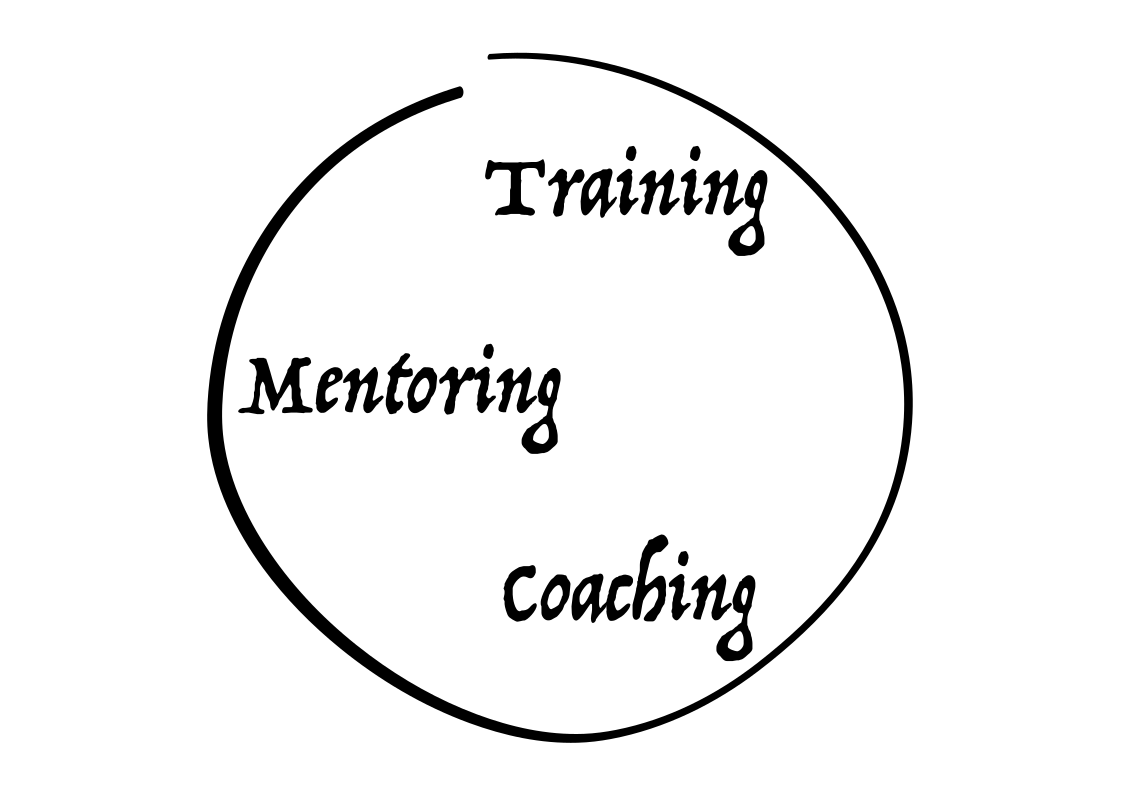
Even if training involves active aspects for the trainee, their role is initially rather passive. The trainee is taught knowledge for later practical application. In this sense, training is the 1st stage.
Stage 2: The trainee applies the trained knowledge, but needs further support to ensure that he/she works as error-free as possible. This transforms the trainee into a coachee, as he/she now enjoys problem-related real-time support, i.e. subject-specific coaching.
Stage 3: The coachee has matured professionally, can deal with challenges adequately thanks to suitable training and coaching, and has thus achieved proficiency. However, as the requirements are complex, further, less close-knit support is required. The coachee becomes a protégé and enjoys: Mentoring.
These three stages are generally run through in cycles in the world of work. When people started talking about digital transformations, there was corresponding training followed by coaching. In the area of Adaptive Change / Agile & Digital Transformation, the time of mentoring has clearly arrived. In other words, there is a broad mass of people who were once willing to be trained, who then asked for coaching, and now want mentoring, in the hope of being ready for it, which is doubtful at this point.
This brings us to the actual topic: Adaptive Governance.
Understanding the distinctions between training, coaching, and mentoring within Adaptive Governance is key for individuals and organizations seeking to build adaptive capacity, resilience, and effective leadership in complex environments.
Adaptive Governance Training:
- Purpose: Builds foundational knowledge and skills for stakeholders to dynamically modify governance systems and policy responses.
- Format: Structured, curriculum-based sessions (workshops, seminars, courses).
- Focus: Capacity building for individuals and teams. Teaching frameworks, principles, and tools for adaptive governance.
- Emphasizing flexibility, collaboration, and continuous learning.
- Outcome: Participants gain practical knowledge and techniques to apply adaptive governance in real-world contexts.
Adaptive Governance Coaching:
- Purpose: Provides personalized, context-specific guidance to enhance adaptive capacity and leadership performance.
- Format: One-on-one or small group sessions, often ongoing and tailored.
- Focus: Enhancing decision-making and strategic foresight. Addressing real-time challenges and feedback. Supporting behavioral change and resilience in complex, uncertain environments.
- Outcome: Individuals or boards develop the ability to respond adaptively, integrate learning, and strengthen governance effectiveness in practice.
Adaptive Governance Mentoring:
- Purpose: Facilitates developmental relationships where experienced individuals (mentors) support less experienced ones (protégés) in their adaptive governance journey.
- Format: Informal or semi-structured, long-term relationships.
- Focus: Knowledge transfer, sharing of tacit experience, and emotional support. Adjusting guidance to match the protégé’s development level and context. Encouraging growth in both technical skills and adaptive mindsets.
- Outcome: Protégés gain confidence, practical wisdom, and adaptive skills, often through ongoing feedback and mutual learning. Mentoring fosters both professional and personal development in adaptive governance settings.
In a nutshell:
- Agile Transformation Management changes the whole system for agility.
- Organizational Change Coaching supports people through change.
- Adaptive Governance Mentoring supports leaders and governance structures to be more adaptive and resilient.
The flaw in this cyclical system: first, training was required, then coaching. Now, mentoring is the new big thing. As far as adaptivity and its degree of maturity are concerned, especially in large, long-established organizations, this degree of maturity is almost invariably overestimated by those involved. In other words, where mentoring is required, coaching is actually needed, and often training as well.