
The Dark Forest
One
Thirty thousand years ago, there was a maximum of 300,000 anatomically “modern” humans living worldwide. They shared the planet with anatomically less “modern” humanoids, who were hardly friendly toward each other, as it can be assumed that the two groups were unable to communicate.
Thirty thousand years ago, only about 30 percent of the world was covered by forest; open landscapes such as tundra, savannah, steppe, and desert predominated. These were landscapes from which enemies could be seen from a distance. Nevertheless, for the people of that time, the world was a dark forest.
The Chinese author Cixin Liu coined this term in his science fiction novel “The Three-Body Problem.” Part two is also called “The Dark Forest.” This part is set many hundreds of years in the future. Humanity is “haunted” by another intelligent civilization—one could also say overrun and subjugated. Cixin Liu envisions the cosmos as a dark forest populated by civilizations of varying degrees of sophistication with unclear technological capabilities, scattered across vast interstellar space. His thesis: as soon as a civilization has the technological capabilities to discover another, alien civilization, it must destroy it immediately so that the aliens do not get them first.
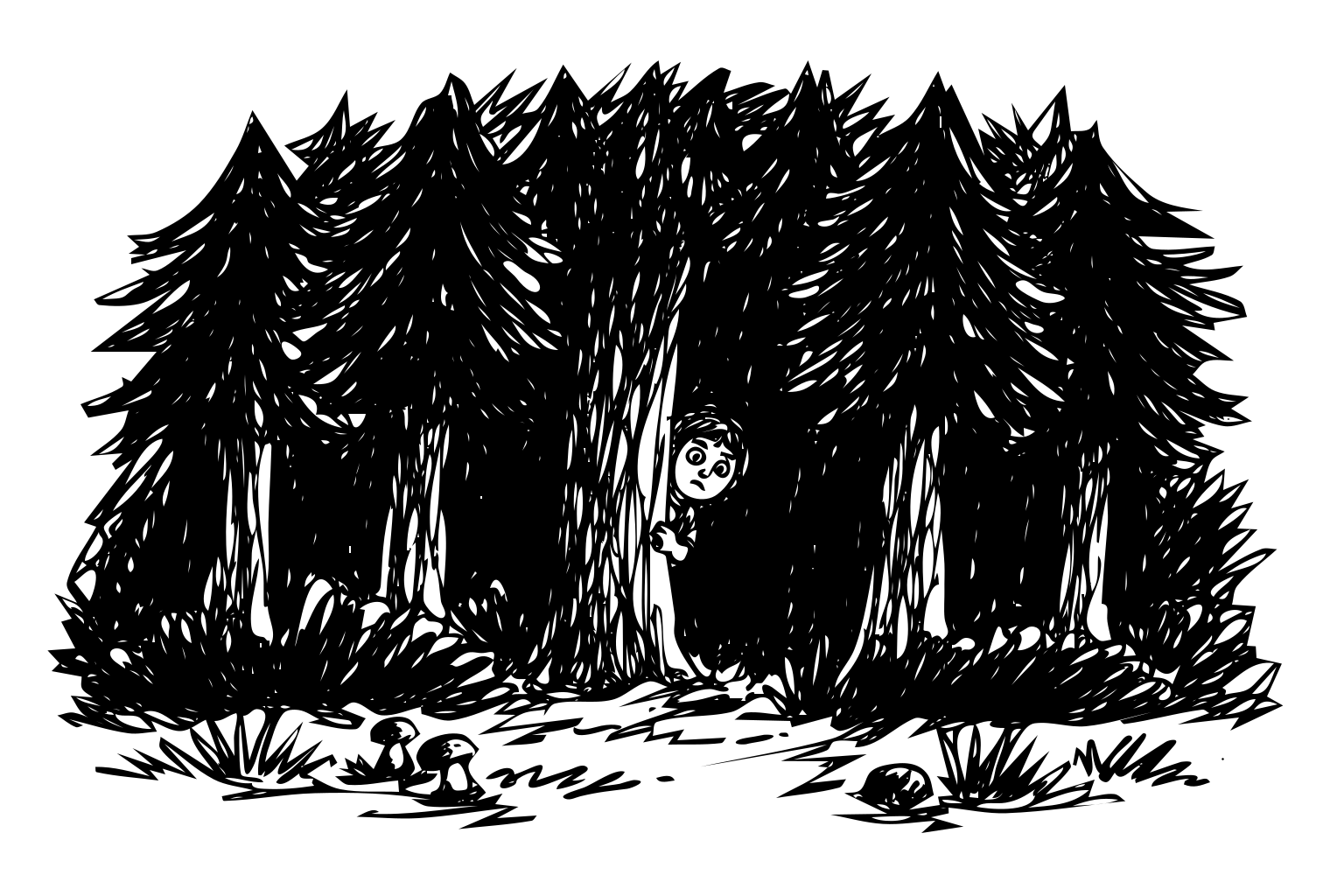
According to this theory, the stupidest thing a civilization can do is to broadcast its own existence into space. Attempting to make contact with another civilization must be avoided at all costs, as this would reveal its own location in the universe as well as its existing technological capabilities. The result of this reasoning is a compulsive first-strike scenario in the dark forest of interplanetary space. The thought, “Hurray, ET is hiding there somewhere, tiny, cute, and harmless,” is turned into its deadly opposite.
What if? – The answer to this question determines possible futures, namely life or death.
In this sense, the world 30,000 years ago was also a dark forest. By this time, Homo sapiens had probably already successfully exterminated other early human species, such as the Neanderthals. The direct ancestors of today’s so-called modern humans roamed the vast expanses of the earth in small to large groups. They were so spread out geographically that a wide variety of dialects and languages developed, which in turn could cause enormous misunderstandings. In short, although Sapiens had already successfully wiped out Homo neanderthalensis, rudolfensis, and other early humans (in some cases even integrating them into their own genome), the dark forest did not become a light one. Bone finds bear witness to massacres.
In other words, because conditions were so adverse (not least due to the existence of other wild animals, diseases, and problematic environmental conditions), the astonishing survivability of Sapiens that had been demonstrated up to that point continued to be in demand.
Historian Yuval Noah Harari believes that the cognitive abilities of Homo sapiens 30,000 years ago significantly exceeded the average brain power of their modern-day counterparts – even though the hunter-gatherers of that time did not formulate the uncertainty principle or the theory of relativity and were unimaginably far away from developing a quantum theory. However, they were apparently able to develop very good answers to what-if scenarios.
Their survival and numerical growth prove this. 10,000 years ago, at the end of the climatically uncomfortable Ice Age, humanity had grown from a few hundred thousand individuals to several million.
During those millennia, hunter-gatherers still roamed as nomads in small to large groups. They had to reckon with the possibility of encountering hostile members of their own species, as well as predators of other species and dangerous weather changes at any time.
What if? – The trail behind the next bushes takes a dangerous turn, the clouds in the sky hint at a hurricane, there is no water to be found behind the next hills, but instead an ambush by a foreign horde?
These are questions of existential importance, leading to answers that determine life and death. As mentioned, the answers that the people of that time found must have been good, otherwise we in our days would not exist.
The social structure of hunter-gatherers is generally described as egalitarian (Harari), but it can be assumed that there were forms of expertise that generated task-related leadership. Within nomadic groups, some were particularly good at tracking, others at starting fires, and still others were particularly talented at hunting or predicting weather changes. This is an assumption, not historically proven, as there is no evidence to support it. However, it seems implausible that talent only emerged in modern times.
It can therefore also be assumed that hunter-gatherer groups were already cross-functional, in the sense that they worked together to combine a wide variety of talents necessary for survival. To return to Cixin Liu and his Dark Forest: The stupidest thing a hunter-gatherer group could do at that time was to light a huge fire with a massive cloud of smoke rising into the sky: Hey, everyone, look, here we are. And then go to sleep. Even on the eve of sedentism, the dark forest remains very dark.
At this point, the theme becomes clearer: the groups of hunter-gatherers were presumably cross-functional. And they probably also gathered and huddled together (scrum), like a rugby team on the field before the start of a game, to encourage each other for the adventure ahead.
What if? Decision-making for the best answer is required here. For hunter-gatherers, this decision-making must have been highly situational and adaptive.
Two
With sedentism came the well-known necessity of protecting not only one’s own life, but also land and property. Human agglomerations needed to be organized sensibly (Lewis Mumford) – not least for successful defense against both human and climatic enemies. The question of “what if” took on other dimensions: numerical, temporal, spatial. Social, political, and economic hierarchies that have developed over time are an attempt at suitable organizational responses. These responses increasingly concern temporal, spatial, and numerical circumstances, because soon there is talk of kingdoms, empires, and nations.
Apart from the early democracies in pre-Christian Athens, where “rule by the majority” was already being tried out, empires and nations were almost without exception ruled by potentates, if not tyrants, i.e., more or less mercilessly top-down. Until recently, this has also been true of companies and enterprises of all kinds. In other words, the top management thinks and decides, middle management thinks along and distributes the decision, and the base (the employees) implements and executes.
This worked very well as long as existing dependencies were simple to complicated. The German automotive industry is a prime example of this (until a few years after the turn of the millennium). Craftsmanship, scaled up industrially, organized as a corporation, ultimately even transnational, yet with a single individual at the top who, at least in principle, had the final say in all decisions. Until various scandals marked a tipping point. Industry 1.0—and with it the entire classic organizational model (top-down, line organization)—was suddenly under pressure, visible to all.
At the same time, a new organizational model gained momentum: Scrum for software production, also known as Agility. In this environment, developers became, in a sense, hunter-gatherers, moving nomadically and exploring new, uncertain terrain. Quite a few of them were also so-called digital nomads. Virtually nothing in the field of IT was merely complicated. In the context of software, it is said that the production environment exploded into complexity. The result: so-called learning loops, i.e., regular reviews of results in order to gain further insights as quickly as possible. A bit like the hunter-gatherers who moved tentatively and searchingly from waterhole to waterhole, hoping not to be killed unexpectedly by human enemies or eaten by animals along the way. Crashes and total failures are very real enemies in the coding environment as well. Only constant improvement, i.e., adaptation, can keep these challenges at bay.
At the turn of the millennium, the world population was around 6.5 billion people. Statistically speaking, these 6.5 billion people were much more peaceful than ever before. Illness and financial ruin are now perhaps considered the greatest enemies in the dark forest of the present – even more so than climate change and the threat of war.
It is now widely recognized that constant, iterative improvement is crucial not only in software development, but also in organizations of all kinds, right up to government organization and leadership. This includes the realization that cross-functional and self-organized teams of 5 to 10 people are much better suited to handling complex tasks than hierarchically managed departments with significantly more staff.
Based on this principle (and, of course, equipped with far better local knowledge), the Afghan mujahideen, operating in small groups, had already driven out the conventionally deployed Soviet army by the end of the 1980s.
Three
But in 2025, Scrum suddenly sounds like Scum, and Agility is pejoratively referred to as a “lame” if not “dead horse.”
What happened?
First, in the wake of the Scrum methodology and the buzzword “Agile,” a wave of joyful anticipation had built up, which was great to ride for a while, but was bound to collapse because the associated expectation was simply wrong. Namely, the expectation that increased participation by the knowledge workers involved would necessarily lead to a kind of grassroots democratic change, i.e., a reduction or possibly even elimination of hierarchy. Old-school managers were as unhappy with this expectation as modern knowledge workers were disappointed when it failed to materialize. Accordingly, both parties expressed extreme frustration. Agile is rubbish because anarchy is not feasible after all, and punk in business is nowhere to be seen.
Secondly, democracy and thus the principle of participation itself suffered a major setback with the rise of modern potentates, one of whom was even re-elected in the US.
And thirdly, AI happened. What the latter actually means is even more unclear as all kinds of self-proclaimed specialists suddenly talk about AI agents and act as if superhuman intelligence is now at our disposal, just because answering emails can suddenly be automated and entire software platforms can now be “vibe coded.”
Hey, folks, I understand your irritation. Aspects one, two, and three have already hit hard. Now the next VUCA cloud is obscuring the view, dripping down from these three.
But does this mean that constant improvement is becoming obsolete?
I say: definitely not!
Four
The world today seems complex, if not largely chaotic. The fact that some people consider climate change to be a fairy tale, a possible military conflict between the superpowers USA and China to be dystopian babble, and vaccinations themselves to be superfluous, does not make reality any easier, but rather causes further quasi-chaotic turbulence with factual distortions via so-called media echo chambers. Or the seemingly exact opposite: the scientifically based assumption that humanity may wipe itself out in the near future. The darkness in the forest is becoming even darker, so to speak, due to multipolar, mutually exclusive basic assumptions and the breakdown of a common consensus. The level of danger is increasing, and the need to act as quickly and sustainably as possible is growing at least to the same extent. Terms such as constant learning, constant improvement, iteration, and retrospectives are thus becoming even more valuable because they are indispensable.
Does this mean the end of vertical organizational structures?
Certainly not.
Corporations are not transforming themselves into egalitarian and participatory start-ups – if such entities (on this side of a longed-for utopia) even exist with the attributes mentioned.
States will continue to be governed by a head of state. Whether this is more dictatorial, i.e., top-down (possibly even tyrannical), or rather participatory and thus fundamentally democratic will also be decided by the extent to which anti-democratic and democracy-weary naysayers are able to transform themselves into promoters of a free constitutional order who are willing to participate.
This seems all the more challenging given that bureaucracy in its current form, as seen in many European countries, appears to be a thing of the past. It is too bloated, too expensive, too inefficient, and unsuited to the constantly changing complex challenges of the present day.
The same applies to corporations that are threatening to suffocate under their bureaucratic structures. The superficial diagnosis is that they are dying from immobility.
From a systemic perspective, cybernetic interactions in the world are currently going through the roof.
The associated problems will not disappear just because agile transformations are difficult, many have already failed, and agility is now being declared dead.
This declaration of death is a hype, just as the buzzword “agile” was.
Five
Why do we at Adaptomos feel called upon to remind you, dear readers, of early human history, to address the adversities faced by hunter-gatherers, to draw parallels with Cixin Liu’s concept of the Dark Forest, to postulate a turning point with the shift from the industrial to the informal age, further fueled by the emergence of AI and the associated extreme increase in complexity in all aspects of daily life?
Why are we opening this pit of snakes?
We must conclude that the level of complexity prevailing today corresponds to that of 30,000 years ago. The reality of life for hunter-gatherers was highly complex, a complexity woven from a multitude of potentially deadly enemies and climatic threats that collectively condensed into the scenario of the Dark Forest.
The transition from a nomadic culture to a settled one was successful because it minimized the number of potential threats.
With the entry into the informal age, this mechanism of mitigation no longer applies. Interactions, dependencies, and possibilities multiply and threaten us as they did in the primeval forest. It is the jungle of data lines, instant messages, and global echo chambers. In a wondrous, technologically induced way, the world has been thrown back into a future in the Dark Forest.
We are convinced that cross-functional, highly adaptable small groups, such as those of hunters and gatherers 30,000 years ago, are best equipped to navigate the Dark Forest of the present and be productive (in the sense of a value-adding survival strategy).
This is the time for teams.