
The best of times
„It was the best of times, it was the worst of times, it was the age of wisdom, it was the age of foolishness“. Charles Dickens wrote this 165 years ago (the beginning of “A Tale of Two Cities”).
Right, certain things repeat themselves.
People in the year 2025: happy and saddened to death, optimistic and pessimistic simultaneously—the paradox of our times.
In his bestseller “The Changing World Order”, Ray Dalio, founder of the hedge fund Bridgewater, analyzes the rise and fall of nations and empires. No, history is not repeating itself. And yes, it does. On the one hand, everything always turns out unpredictably differently, and on the other hand, more similar than you may think.
Exactly, the next paradox. In other words, innovation happens (almost) unpredictably. But history (seen from a bird’s eye view) progresses logically and therefore (in principle states and phases) predictably.
We (humans) are aware that we were born and will die (even if we don’t want to admit the latter). We are rationally aware that nations come into being and possibly pass away. We learned in history class that empires rise and fall (like the Roman Empire), but the majority of us think this is negligible because it doesn’t seem to matter in our lifetimes.
Until the moment when the end of a cycle is approaching again, and suddenly, a lot of people seem very alarmed.
What will go down? Who will rise?
With all due respect, we would like to leave it to you, dear reader, to answer these questions. What we would like to answer, however, is the question of what is urgently needed in a time of accelerated descents and ascents.
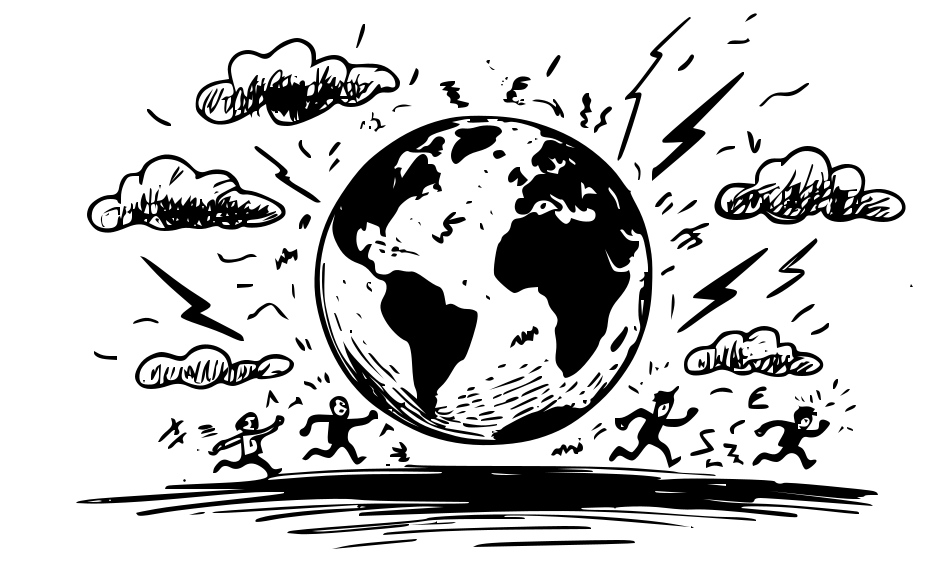
Societies, countries, nations, and empires rise because 1. the level of education of the population increases, 2. innovativeness increases, and 3. competitiveness increases. And they decline, possibly even go under, because these markers decline in reverse order.
The reason always seems to be the same: at the height of success, too much money is spent, and the debt grows. Money is borrowed or printed in order to carry on as before, but this becomes increasingly unaffordable, which is why bankruptcy threatens, and the success curve tilts for all to see.
Now, the people who want to turn back the clocks are coming forward.
They want to preserve, restore, but they only make things worse. Restoration has never worked at any time in history. Not for the Romans, not for the Dutch, not for the British. And it will not work for the Americans either.
These are the best of times: Life expectancy is increasing thanks to ever-improving medical care and the increasingly successful fight against life-shortening diseases, and then AI is hitting the headlines like the printing press or the invention of the light bulb in the old days. No, AI is much more than that …
And these are the worst of times: The shadow of depression has settled over the economy—the result of shockwaves emanating from the unpredictable follies of an imperial fool, and the possibility of a great war looms.
What helps in these moving, paradoxical, frightening, and fascinating times? Methodical resilience through consistent adaptability to increase innovation and competitiveness. Adaptomos stands for nothing less.