
Tebiki for Companies
Like Ikigai, Tebiki (手引き) is a Japanese word meaning “guidance”, “guide” or “introduction”. It is made up of the kanji 手 (te) for “hand” and 引き (biki) for “pull”, which literally implies a kind of “hand guidance”. Tebiki for companies is a development by Robert Hopp and the author of this article, based on the concept of Ikigai, and is intended to serve as a kind of compass for decision-making.
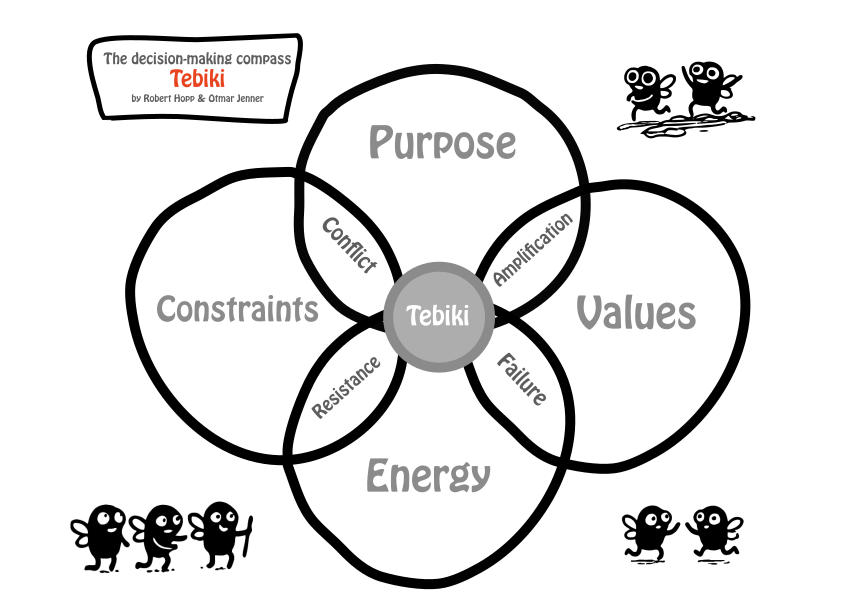
Tebiki is inspired by robotics and the question:
How do you control a robot?

Use the four aspects—Purpose, Values, Energy, and Constraints—to guide behavior with specific components:
1. Purpose
The robot’s purpose defines its primary objective or task. For example, if the robot is designed to deliver packages, its purpose would be to ensure accurate and timely delivery. This aspect acts as the overarching goal that informs all decisions in the control system.
- Implementation: Define high-level objectives and break them into smaller, actionable tasks (e.g., navigation, object handling).
- Control Strategy: Use task planning algorithms like Model Predictive Control (MPC) to ensure the robot prioritizes its primary objective while balancing secondary goals like energy efficiency.
2. Values
Values represent the ethical or operational principles guiding the robot’s actions, such as safety, fairness, or environmental sustainability.
- Implementation: Incorporate rules or constraints that reflect these values. For instance:
—Safety: Avoid collisions using obstacle detection and avoidance algorithms.
—Sustainability: Minimize energy consumption by optimizing trajectories. - Control Strategy: Use multi-objective optimization to balance competing values (e.g., speed vs. energy efficiency)
3. Energy
Energy management ensures efficient use of power resources, which is critical for autonomous robots with limited battery life.
- Implementation: Model energy consumption based on factors like speed, acceleration, and sensor usage.
- Control Strategy:
—Optimize movement parameters (e.g., speed and acceleration) to minimize energy consumption while meeting timing constraints.
—Use techniques like Bayesian optimization to learn energy-efficient trajectories over time.
4. Constraints
Constraints define the physical, temporal, or environmental limits within which the robot must operate.
- Implementation: Identify and encode constraints such as:
—Physical: Maximum joint angles or speeds.
—Temporal: Deadlines for task completion.
—Environmental: Navigating around obstacles or operating in confined spaces. - Control Strategy: Employ constraint-based planning methods to ensure all actions respect these limits. For example:
—Use operational space control to define motions within permissible ranges.
—Integrate variable impedance control for safe and adaptive interactions with dynamic environments.
How to use Tebiki, the Decision-Making Compass?
Ask good questions!
Asking (and answering) the following questions is best achieved collaboratively in self-organized teams:
Purpose and Values
Question: Which values are essential to achieving the defined purpose?
Values serve as the moral and ethical foundation guiding decisions. For example, sustainability, integrity, or innovation might be critical depending on the company’s goals.
Aligning purpose with values ensures authenticity and fosters trust among stakeholders.
Purpose and Energy
Question: How much energy (resources, time, effort) should be devoted to achieving the purpose in alignment with these values?
Energy allocation involves prioritizing tasks that directly contribute to fulfilling the purpose while maintaining efficiency. This includes human effort, financial investment, and emotional commitment. Leaders must assess whether their teams can sustain focus on the purpose without burnout.
Purpose and Constraints
Question: What constraints (internal or external) might hinder implementation?
Constraints could include market limitations, regulatory barriers, resource shortages, or cultural resistance. Identifying these obstacles early enables proactive strategies to mitigate them. For example, constraints might require redefining goals or seeking innovative solutions to achieve alignment with values without compromising feasibility.
How can Ikigai be combined with Tebiki?
Considerations of values, energy, and constraints can form a robust decision-making compass for a company.
1. Define Your Purpose
Start with a clear articulation of your company’s purpose. What is the reason for being, and how does it align with the mission and vision of the company?
2. Identify Values
List out the core values that are important to your company in relation to the defined purpose. Values could include:
- Integrity: Commitment to ethical behavior and transparency.
- Innovation: Encouraging creativity and new ideas.
- Sustainability: Commitment to environmental and social responsibility.
- Customer-centricity: Prioritizing customer needs and satisfaction.
- Collaboration: Promoting teamwork and partnerships.
3. Assess Energy Requirements
Determine the amount of energy and resources that will be necessary to pursue the purpose effectively:
- Human Resources: Do you have the right talent in place? Will you need to hire or train employees?
- Financial Resources: What is the budget requirement for initiatives aligned with your purpose?
- Time: How much time do employees and leadership need to dedicate to achieving this purpose?
- Motivation: Are your team and stakeholders motivated and engaged with the purpose, and how can you sustain that engagement?
4. Identify Constraints
Evaluate the constraints that might hinder the implementation of your purpose:
- Cultural Constraints: Are there existing cultural barriers within the company that could resist change?
- Market Constraints: Is the market ready and open to your purpose, or are there competitor actions that could undermine it?
- Resource Constraints: Are there limitations in terms of budget, staff, technology, or time?
- Regulatory Constraints: Are there legal or regulatory barriers that should be considered in relation to your purpose?
Create your Decision-Making Compass
Important: Determining the purpose, the corresponding values, the necessary energy and constraints is best achieved collaboratively in a self-organized team!
Bring all the following elements together to create a structured decision-making compass that guides your actions:
- Purpose Statement: [Insert Your Company Purpose—determined via Ikigai]
- Determine the three remaining elements of Tebiki
- Values Alignment:
[Value 1]: How does this value support our purpose?
[Value 2]: How does this value support our purpose?
[Value 3]: [Continue as needed] - Energy Assessment:
Human Resources: [Detail staffing needs and training]
Financial Resources: [Outline budget needs and potential funding sources]
Time: [Estimate timeframes for initiatives]
Motivation: [Describe plans to maintain high motivation] - Constraints Identification:
Cultural: [List cultural barriers]
Market: [Outline potential market issues]
Resource: [Identify specific resource constraints]
Regulatory: [Detail any legal considerations]
Conclusion
Using this decision-making compass allows the company to align its daily operations and strategic initiatives with its purpose by assessing relevant values, energy requirements, and potential constraints. Regularly revisiting and updating this compass can ensure that the organization remains adaptable and responsive to changes in the internal and external environment, ensuring alignment with its core purpose over time.