
In the Dark Forest, Part Two
As mentioned, Chinese science fiction author Cixin Liu (The Three-Body Problem) originally coined the term, referring to the vast, dark interstellar space, in whose expanses alien advanced civilizations may exist. Since they have no common language, it is virtually impossible to express peaceful intentions during initial contact, which is why Cixin Liu assumes that a civilization will launch a first strike of annihilation as soon as it becomes aware of the existence of another.
The universe is thus a dark forest from whose depths a devastating first strike can come at any time without warning—for example, against us, humanity.
As explained in our previous article, for hunter-gatherers 30,000 years ago, the world was also a Dark Forest.
Over the past millennia, humanity has increasingly transformed the Dark Forest into a bright park landscape. The result of sedentarization, civilizational achievements, technology, etc.
We would like to suggest that the world is currently returning to a state of the Dark Forest—or has already done so.
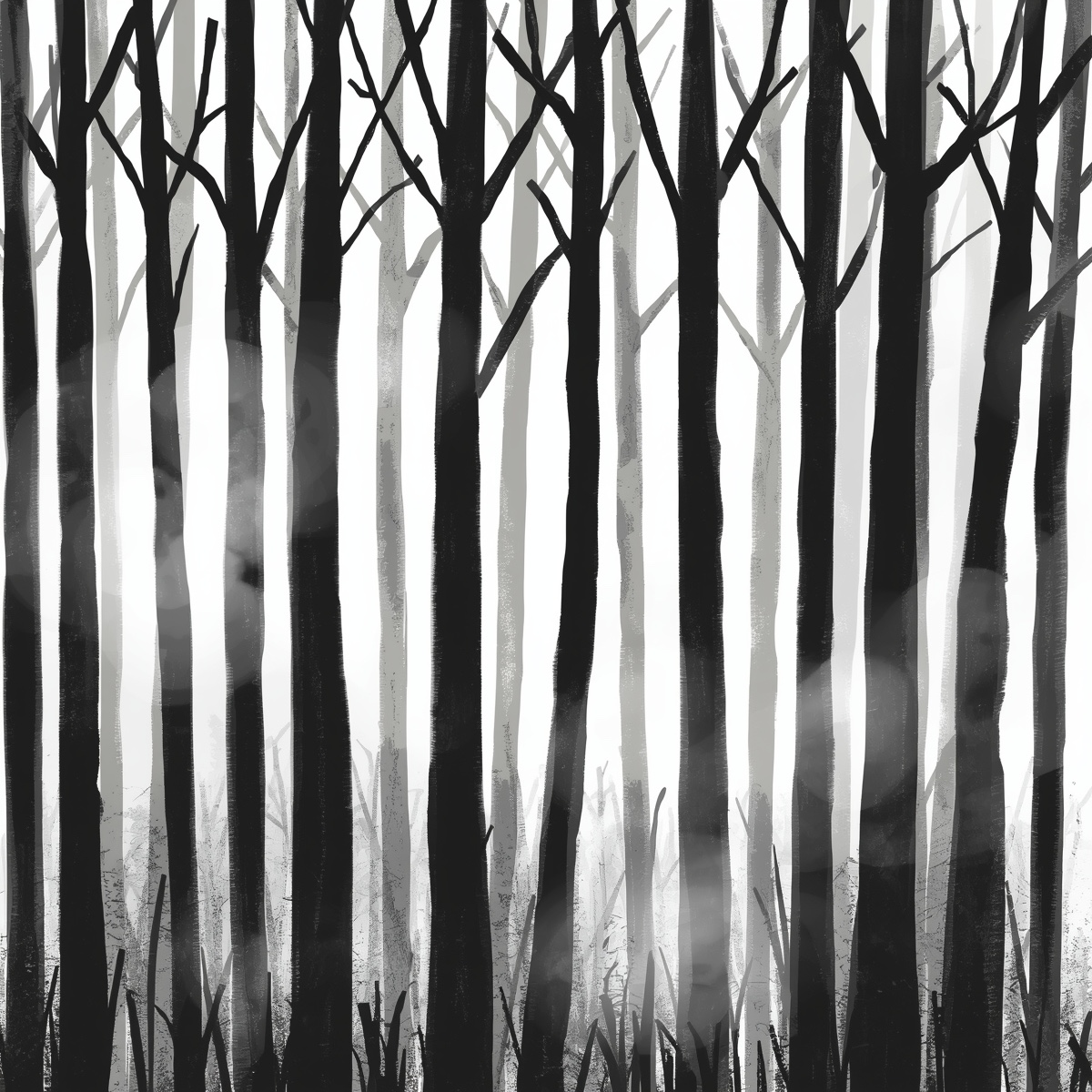
What characterizes the Dark Forest? The lack of predictability. Essentially, life-threatening unpredictability and thus a stark compulsion to act, without the opportunity to weigh up options and develop intelligent avoidance scenarios. In the Dark Forest, nothing seems predictable – except the probability of possible instant death.
What does the bright park landscape stand for? An order that is so logical and clear that meaningful conclusions and connections appear possible at any time, including an improved ability to play through ‘what-if’ scenarios, communicate about them, and derive further intelligent design ideas from them.
Sorry if that sounds very abstract.
In the Dark Forest 30,000 years ago, we claim (and this is by no means scientific, but only a logical assumption) that individuals could hardly survive for a variety of reasons. Even if they managed to escape animal and human enemies as well as climatic hardships, they would perish due to a lack of reproduction.
On the other hand, large groups had problems obtaining enough food (Harari) and were also less mobile than small ones. Also not good.
In the so-called ‘bright park landscape’, nutrition became less and less of a problem, while the need to defend cities and farmland grew at the same rate. The results were armies, complex hierarchies, bureaucracies, industry, technology, an explosion of knowledge, and finally digital data streams, virtual worlds, and AI.
All this is undoubtedly an oversimplification at this point. But interestingly, overcomplexity is the preliminary result of this development. And so we as humans are back to square one—thrown back into the Dark Forest, so to speak.
There is clear evidence of this. During the First World War, for example, huge armies clashed, strictly controlled by hierarchy. The so-called battles of materials were, in reality, floods of people pouring out of endless trenches, with few exceptions, such as at Christmas.
There is much to be said about warfare in the Second World War, but Vietnam is more relevant to the discussion here. A powerful, conventional army, namely that of the United States, invades the country, wreaks incredible havoc—and yet is forced to withdraw because it cannot defeat the Vietnamese guerrillas despite extensive deforestation of the jungle. This is also a simplified representation, but the aim here is to provide a fundamental understanding.
Then, Afghanistan in the late 1980s. After around ten years of war, the conventional Soviet army was forced to withdraw. Defeated by Afghan mujahideen, who operated in small groups and units in an environment that, from the perspective of the Soviet army, was a dark forest. The author of this text (a crisis reporter at the time) was in Kabul immediately after the withdrawal of Russian troops, staying at the same hotel as Mujahideen leader Gulbuddin Hekmatyar, for example.
Finally, Russia’s invasion of Ukraine. Again, a conventional army. Controlled by a classic hierarchy. A huge machine rolling into the country—and initially making advances that threatened to become a march through.
The Ukrainian defenders respond with spontaneous adaptation and agility at the level of small groups and teams, rather than at the level of large formations. A few months ago, a high-ranking officer in the German Armed Forces confirmed this to me as a fundamental principle. ‘Otherwise, the Ukrainians would have been defeated long ago.’ For the Russian army, Ukraine has proven to be a dark forest—woven of surprising complexity that the defenders oppose the attackers with.
We are addressing this issue here because significant civilizational turning points often announce themselves on the battlefields.
Why is this potentially relevant to civilization in a sense that may go beyond this?
Because we assume that the world as a whole has been thrown back from the stage of a civilized garden into the present of the Dark Forest.
The most pressing question now is: What works in the Dark Forest?
Acting alone tends not to work. The so-called culture of individualism, the principle of isolation and singular life paths, is reaching its limits and appears to make little sense as a means of ensuring survival.
Even large hierarchical organizations and bureaucratic structures lose themselves in the fog of uncertainty in the Dark Forest.
On the other hand, cooperation in small groups based on individual expertise offers the greatest advantage for tentatively moving forward in the Dark Forest and surviving.
So this is the comeback of the family, one might think. Not exactly. The family as a hierarchically organized structure seems just as unsuitable as large top-down departments and organizations.
In fact, self-organized teams led on the basis of individual expertise, which can change depending on requirements, are currently the best answer for survival in the Dark Forest. And we are talking here less about biological death than economic extinction.
So much for this second part on the Dark Forest.
In the following articles, we will take a closer look at the forms of organization that ensure survival in the Dark Forest.