
Emotions are the key in 21st century
„Teamwork has always been crucial to individual survival and humanity’s extraordinary success, but its importance has been amplified by the new reality of our hyper-connected environment,“ writes Dr. Hannah Critchlow, a neuroscientist at the University of Cambridge and author of the bestseller *The 21st Century Brain*.
Phew – that’s a huge relief for us here at Adaptomos. Emotions are the key, explains Critchlow. How we interact with one another is determined primarily by feelings rather than logical considerations and rational intentions.
This Critchlow explains „led to a new science of emotions.“
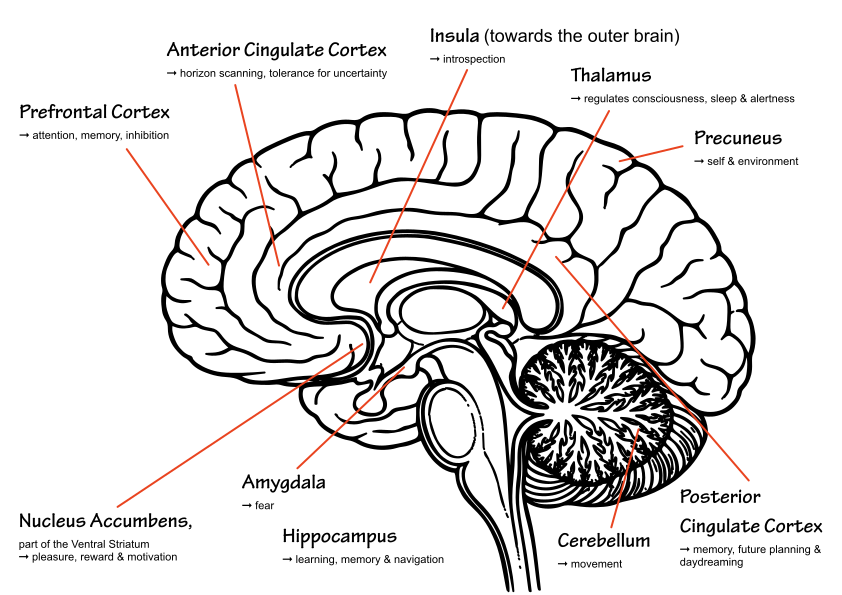
Psychological safety, the so-called ‘well-being index’, identification with the company and emotional attachment – all of these were considered extremely important in the era of Industry 3.0.
But then the upheavals in global politics began, and ever since the message has been: ‘People, you need to deliver results. Just make your company great again.’
‘The new world of work – economic crisis and competition from AI: everyday working life is getting tougher’ is the current headline in Germany’s *Der Spiegel*.
There is talk of mass layoffs resulting from AI, which is why job seekers currently need to “brace themselves.”
Top-down management is currently making a comeback, the article states. Despite widespread uncertainty, managers are now back in the driving seat.
To remind you: AI is, above all, a promise. Of course, anything that can be automated will be automated. But AI cannot replace emotional intelligence and human ingenuity, because AI can only recombine data – and do so incredibly quickly. This makes human intelligence all the more essential for evaluating the results.
The subtitle of Dr Hannah Critchlow’s bestseller “The 21st Century Brain* is “Cutting Edge Neuroscience to Help Us Navigate the Future”.
Yes, we need help.
In a world undergoing radical change, we are more dependent than ever on human creativity to find sustainable solutions. Will AI find these solutions for us on its own?
I don’t think so.
People will – or more precisely, teams of people, and even more precisely, intelligent teams.
„Your feelings can dial your intelligence up – or down,“ writes Dr. Critchlow. „Emotional intelligence lies at the root of collaboration. Empathy is rocket fuel for an evolutionary shift.“
Hence, my prediction: the retreat to a top-down approach and a fear-driven culture of coercion is merely a temporary transitional phase.
The breeding ground for the development of emergent intelligence within a team is self-organisation.
In the face of increasing complexity, meaningful human interaction is more in demand than ever.