AI Literacy & Adaptivity Lab
Our Four-Day Facilitation Deck
Leverage the full added value of AI without undermining the team’s judgment, accountability, and intellectual performance, or eroding trust within the team.
POSITIONING: What the AI Literacy Lab is—and what it isn’t
It is ➞ A practical, hands-on leadership lab | Every block ends in an artifact or a decision | Grounded in one real workflow per participant | A producer of credible AI-literacy evidence
It’s not ➞ A tool catalog or product demo | A prompt-tricks or hacks course | A legal compliance seminar
AI is rapidly becoming an issue for organizations in leadership, governance, and trust—not just a technology problem. Therefore:
- AI Literacy should improve judgment.
- AI belongs in real workflows, not random experimentation.
- Human accountability must stay explicit.
- AI output is probabilistic and must be reviewed.
- Teams need psychological safety as roles shift.
What participants will be able to do after the course:
- Decide what stays human, what AI can assist.
- Review AI output without treating it as authoritative.
- Reduce low-value work while protecting judgment and trust.
- Brief AI with context, constraints, and quality criteria.
- Explain AI-supported work to your team.
- Run limited adaptive experiments instead of a grand transformation.
How we will work during the course:
- With the use of real workflows
- Without pasting confidential data
- Treating AI output as a draft or a hypothesis
- Keeping human accountability explicit
- Asking for help early if we are stuck
INQUIRY SPINE—Five questions that run through the lab:
- What are you really trying to achieve?
- Where does AI add leverage, and where unacceptable risk?
- What must remain human?
- How do we verify quality when output is probabilistic?
- How do we introduce AI Literacy without breaking trust?
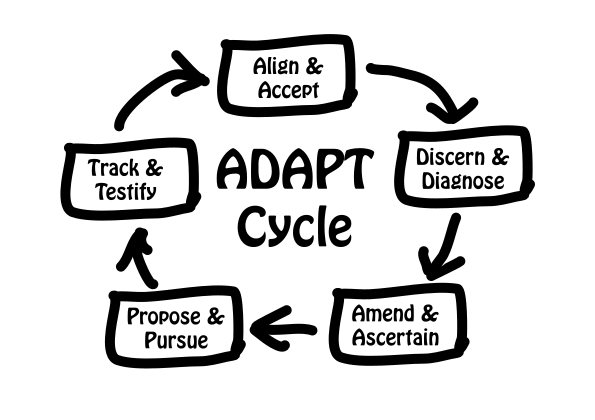
The ADAPT cycle forms the backbone of the course
DAY ONE → AI literacy, reality & judgment
- Demand & reality → OUTPUT: Baseline self-assessment
- AI as probabilistic assistant → OUTPUT: Risk & limit checklist
DAY TWO → AI briefing & new workflows
- From user to orchestrator → OUTPUT: AI briefing template
- Align & Accept → OUTPUT: Workflow intent canvas
- Discern & Diagnose → OUTPUT: Current workflow map
DAY TREE → Testing & Oversight
- Amend & Ascertain → OUTPUT: Sustainable distribution of responsibility
- Testing the workflow → OUTPUT: Workflow test notes & quality gates
- Human oversight → OUTPUT: Oversight protocol & checklist
DAY FOUR → Adoption—Turning the mapped workflow into a human-AI experiment
- Team adoption → OUTPUT: Team introduction & implementation script
- Propose, Pursue, Track, Testify → OUTPUT: Iterative experiment plan
Fundamental aspects of the curriculum:
AI Literacy is not tool familiarity; it is informed judgment in context → Compliance urgency + Leadership value = Informed judgment → (Day One 01)
Generative AI predicts and composes plausible output → Treat it as a draft, a hypothesis, or an assistant contribution—never as a final authority → (Day One 02)
From user to orchestrator → Stop using AI as a tool. Start briefing it like a capable assistant under supervision—the infinite interns you must direct and review → (Day Two 01)
Define context before redesign → Do not apply AI before the work’s purpose is clear. Align on purpose, stakeholders, constraints, sensitivity, accountability, and success → (Day Two 02)
Where AI helps, where it harms → Find leverage in repeated drafting, summarizing, comparing, and checking. Find risk where context, accountability, fairness, or emotion matter → (Day Two 03)
Redesign around responsibility → Redesign starts with responsibility, not automation. AI can draft, summarize, compare, critique, or monitor — but not every task should use AI → (Day Three 01)
Test the workflow → A workflow is not improved by intention—it improves through testing. Run one small, safe AI-supported step and compare it to the current process → (Day Three 02)
Human oversight → Oversight means defined checks, not vague responsibility. Name escalation triggers and no-AI zones, and decide what evidence to retain → (Day Three 02)
Team adoption → AI changes informal power, status, speed, visibility, and expectations. People may fear replacement, surveillance, deskilling, or embarrassment → (Day Four 01)
From redesign to a controlled experiment → The next step is not an agile transformation. It is a controlled iterative experiment (14 days up to 1 month) with a clear hypothesis, boundaries, measures, review rhythm, and stop criteria → (Day Four 02)
Enjoy AI Literacy & Adaptivity!