Adaptive Leadership 4.0
The Adaptivity Advantage for Middle Management
The rise of Generative AI isn’t just another tech trend—it’s a workplace revolution flipping traditional management on its head. We’re witnessing a fundamental shift in how organizations operate, make decisions, and compete. In this brave (and slightly bizarre) new world, an enterprising manager suddenly has “infinite interns” at their disposal—AI agents that can churn out ideas and execute tasks at superhuman speed and scale. But alongside this AI superpower comes chaos: job roles are evolving overnight, required skills are shifting, and power dynamics are being upended by algorithms. The old leadership playbook is quietly combusting, and a new one centered on adaptivity is taking its place.
Why Adaptive Leadership 4.0?
Adaptomos’s Adaptive Leadership 4.0 program (also referred to as the “Adaptivity Advantage” initiative) is our answer to the GenAI disruption. This modular, multi-week leadership course transforms managers from hands-on doers into confident “AI orchestrators,” capable of leading teams of human and AI workers through continuous change.
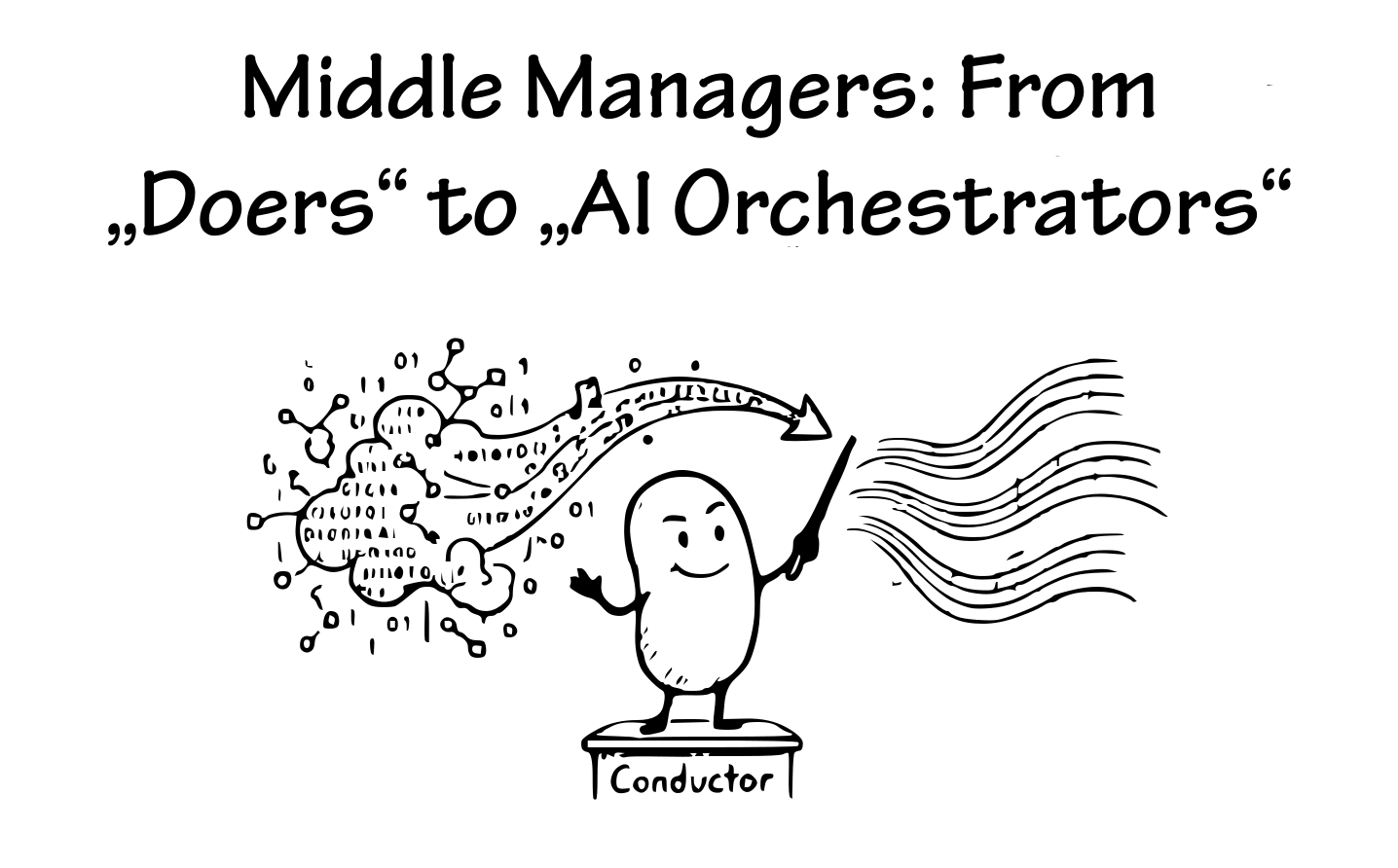
The Adaptive Leadership 4.0 program is designed as a flagship learning experience. We blend rigorous professional development with Adaptomos’s signature wit and candor, because confronting the future of work should be both engaging and enlightening. We’ll poke fun at stagnant corporate habits (“shall we stop having meetings about meetings, please?”), but we never compromise on substance. This program speaks directly to middle managers caught in the GenAI whirlwind.
The mandate for this program is urgent
Recent data reveals that only 8% of HR leaders believe their managers have the skills to use AI effectively, and just 14% of organizations provide adequate support for managers to integrate AI into daily work. In other words, most managers today are winging it with GenAI—a risky proposition when expectations for AI-driven performance are rising. Nearly four out of five HR executives (≈79%) say that enabling employees to use new technologies to drive growth is now a top priority. The message is clear: boosting Adaptivity is now strategic, not optional. Companies that hesitate to adapt will find the landscape shifting under their feet, fast. The Adaptive Leadership 4.0 program is designed to close this capability gap. We help leaders conquer their AI anxiety, turn uncertainty into opportunity, and build adaptivity as a lasting competence across their teams and systems. Crucially, we position adaptivity not as a vague mindset but as a concrete set of actions and habits that managers can practice daily—a strategic leadership skill set to navigate the speed and uncertainty of a GenAI-infused world.
Learning Objectives
Participants in Adaptomos’s Adaptive Leadership 4.0 program will emerge with the perspectives and practical skills needed to thrive as leaders in an AI-powered, fast-changing environment. Key learning objectives include:
Adopt the “Conductor” mindset:
- Shift from being the hands-on problem-solver to a strategic “orchestrator“. Support high-performing teams and act as a “director of infinite interns“. Managers learn to delegate routine execution to AI (infinite interns) to enhance the self-organization and efficiency of human teams in addressing complex challenges. Managers should focus on providing high-level direction, making critical judgments, and orchestrating and coordinating efforts. Understanding when to utilize AI versus human talent is key—such as assigning high-volume, data-intensive tasks to AI while relying on human creativity for strategic insight—ensuring optimal use of both resources. By adopting the role of orchestrators and conductors instead of doers, leaders create space for more valuable thinking and mentorship.
Manage Probabilistic AI Systems with Confidence:
- Develop the skills to lead processes driven by AI systems that don’t always behave deterministically. Managers will learn how to put the “human in the loop” effectively—establishing checks, quality controls, and escalation paths for AI-generated work. Instead of fearing AI’s mistakes or quirks, they’ll treat them as coaching opportunities. Participants become adept at interpreting AI outputs (which are inherently probabilistic), mitigating errors or bias, and deciding where human oversight is non-negotiable. The result is leaders who can leverage AI’s speed and scale while safely managing its risks.
Close the GenAI Adoption Gap:
- Learn how to move from sporadic, ad-hoc use of AI tools to deeply integrating AI into core workflows. Many teams today only experiment with AI occasionally (the “once-in-a-while ChatGPT” phenomenon). This program teaches managers to identify high-impact use cases where AI can augment daily tasks (beyond gimmicks or one-off demos) and to redesign workflows so that AI assistance becomes routine. By program’s end, managers will know how to turn a team of tentative AI dabblers into consistent, fluent AI users – effectively closing the adoption gap and unlocking productivity gains.
Engineer High-Leverage Adaptive Workflows:
- Cultivate the ability to redesign team workflows for maximum impact by automating low-value activities and accelerating iteration cycles. Managers will practice mapping out processes to find the 20% of work that creates 80% of the value—and learn to use AI for the rest (the busywork, data crunching, first drafts, etc.). They’ll internalize that speed of learning is a key metric in the AI era. We teach techniques to rapidly prototype and refine processes in two-week cycles rather than waiting for perfect plans. The objective is to make continuous improvement and adaptability built-in: leaders become comfortable running small experiments, scaling up what works, and discarding what doesn’t—thereby paying down organizational “innovation debt” as they go (replacing outdated procedures and closing skill gaps incrementally).
Navigate Power Shifts & Team Dynamics in an AI-Infused Workplace:
- Understand and skillfully manage how GenAI changes organizational roles, power dynamics, and collaboration. Managers will learn to anticipate shifts—for example, as AI takes over certain coordination or analytical tasks, some traditional roles will diminish while new roles (like AI supervision or data curation) rise. They’ll gain strategies for keeping their teams cohesive and motivated amid these changes, such as repositioning experienced staff as quality guardians and AI “co-pilots” rather than allowing them to feel obsolete. We cover how to address the common fears (“Will AI make me irrelevant?”) and defuse tensions when “the bots” join the team. Leaders will be equipped to maintain trust, clarify new expectations, and ensure everyone finds their place in the augmented team.
Cultivate Adaptivity as a Lasting Muscle:
- Teach adaptivity as both a mindset and a set of behaviors that become second nature. Beyond buzzwords like “agility“, adaptivity in the Adaptomos sense means developing a reflex of continuous learning and adjustment. Managers will practice techniques to remain resilient and curious amid uncertainty, to encourage experimentation and quick learning loops in their teams, and to treat every setback or AI snafu as a chance to learn and improve. Ultimately, they learn to embed a culture that is “intent-driven yet flexible”—keeping focus on meaningful goals while pivoting tactics as needed, so their part of the organization can pivot faster than change itself. By developing this adaptivity muscle, middle managers become strategic assets who drive ongoing innovation rather than clinging to the status quo.
Adaptive Leadership 4.0 ist based on the ADAPT Cycle. Read more here
Curious to learn about the Adaptive Leadership 4.0 curriculum? Read on here