The ADAPT Cycle
Adaptive Leadership 4.0 is a multi-part program combining interactive workshops, practical examples, and coaching, based on the ADAPT cycle. ADAPT stands for:
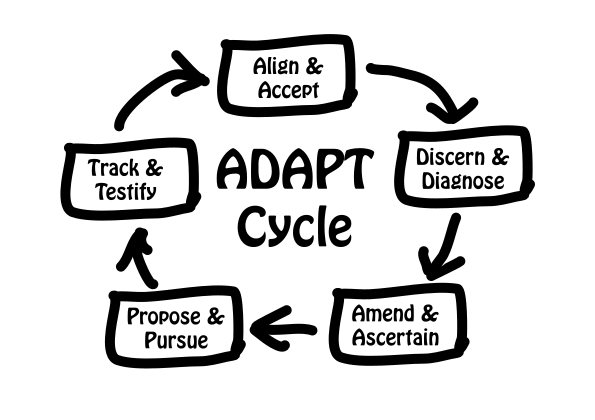
A—Align & Accept; D—Discern & Diagnose; A—Amend & Ascertain; P—Propose & Pursue; T—Track & Testify → on demand start again from the beginning, iteratively.
We at Adaptomos developed ADAPT for you as an iterative coaching framework for the age of GenAI. Let us explain in more detail what ADAPT is all about:
A — Align & Accept
Purpose: To create clarity, psychological readiness, and shared understanding before any change or decision-making process begins
Key Elements:
- Align: Establish a common baseline—goals, constraints, roles, expectations, and context. In a GenAI-enabled workflow, alignment includes identifying where AI fits into the process and what outcomes it is expected to enhance.
- Accept: Foster acceptance of the current reality, including uncertainties, skill gaps, or organizational constraints. This acceptance removes friction and defensiveness, making space for adaptive thinking.
- Clarifying intent and defining success criteria
- Recognizing emotions, resistance, or biases (for example, in connection with GenAI)
- Agreeing on boundaries, responsibilities, and what is not changing
D — Discern & Diagnose
Purpose: To observe, analyze, and understand the actual situation, separating signals from noise.
Key Elements:
- Discern: Identify patterns, opportunities, risks, and blind spots. With GenAI, this also means discerning where AI provides leverage vs. where human judgment must dominate.
- Diagnose: Use structured inquiry to understand root causes of issues, capability gaps, workflow inefficiencies, or decision bottlenecks.
- Conducting data-driven assessments
- Mapping current workflows and friction points
- Identifying blockers (technical, cognitive, procedural, or cultural)
- Separating symptoms from underlying drivers
A — Amend & Ascertain
Purpose: To reframe, adjust, and explore feasible pathways forward.
Key Elements:
- Amend: Modify assumptions, processes, or mental models. In the GenAI age, this may include redefining job scopes, updating prompts, or redesigning human–AI collaboration patterns.
- Ascertain: Evaluate options based on feasibility, risk, and impact. Determine what adaptations are realistic and sustainable.
Behaviors & Deliverables:
- Providing alternative interpretations or solutions
- Refining objectives based on insights
- Designing improved workflows
- Selecting the most viable adaptive changes
P — Propose & Pursue
Purpose: To convert analysis into action—committing to specific adaptive steps and executing them.
Key Elements:
- Propose: Outline clear, actionable plans. These proposals may include new workflows, skill-building pathways, AI usage protocols, or experimentation frameworks.
- Pursue: Implement the chosen plan with intention and measurable milestones.
Behaviors & Deliverables:
- Creating an adaptive action plan with timelines
- Identifying enabling tools, training, and support resources
- Establishing accountability and success metrics
- Running pilots or controlled experiments
T — Track & Testify
Purpose: To measure, review, and institutionalize learning.
Key Elements:
- Track: Monitor progress, measure outcomes, and evaluate the effectiveness of the adaptive actions. Tracking includes both quantitative metrics (efficiency, quality, cycle time) and qualitative markers (confidence, clarity, collaboration).
- Testify: Capture and articulate insights, success stories, challenges, and learnings. Sharing these testimonies builds organizational intelligence and supports future iterations.
Behaviors & Deliverables:
- Reviewing KPIs and qualitative feedback
- Documenting what worked, what didn’t, and why
- Iterating or restarting the ADAPT cycle as needed
- Communicating lessons learned across teams